Machine Builds Machine
The limit is not model intelligence, but rather the source of intent

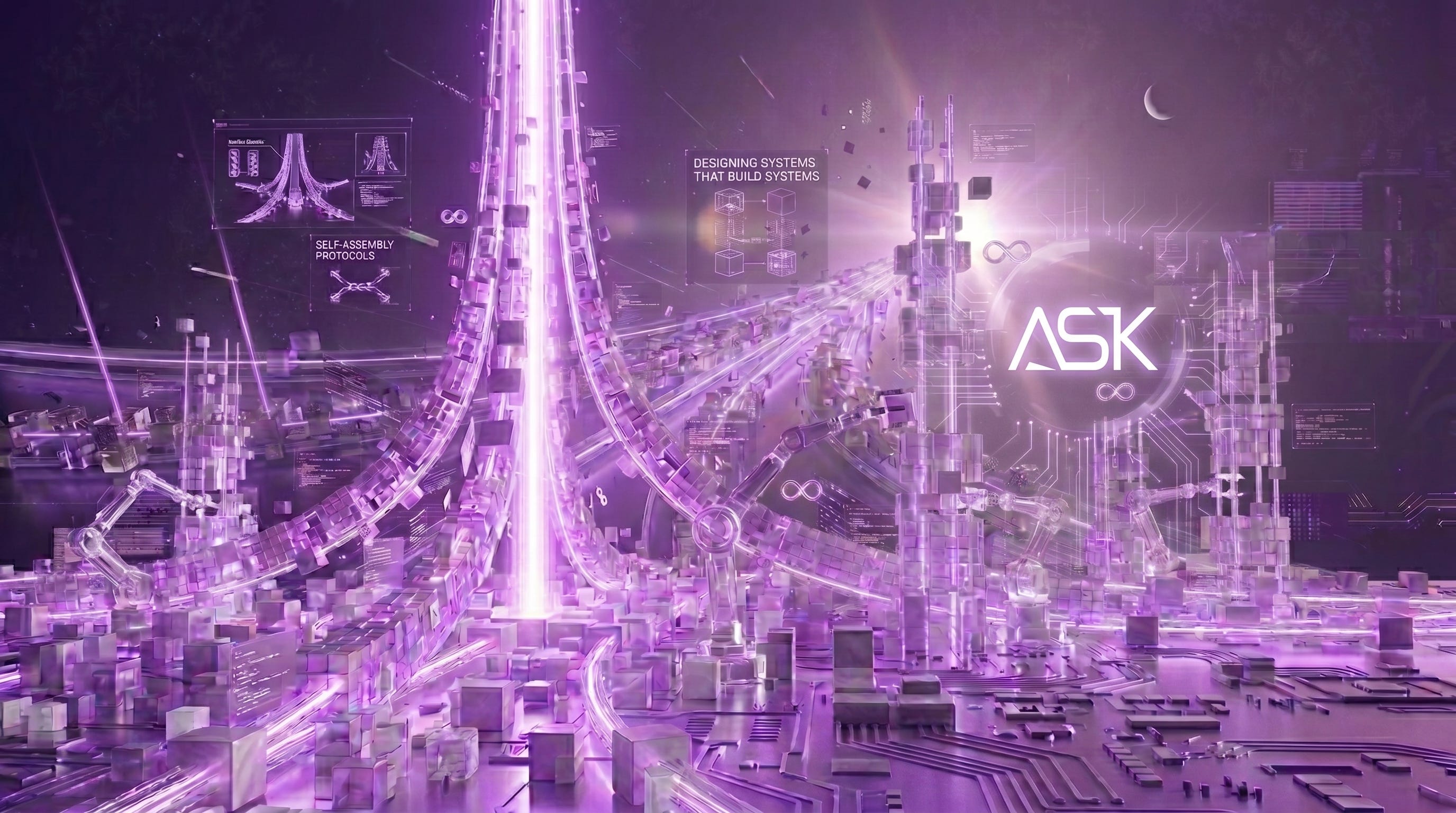
The cycles are getting shorter.
The workflow this series describes — fresh-context critique, advisor-role synthesis from outside execution momentum, execution-surface implementation that stops at exact scoped diff — is starting to stop sooner. The pressure surface saturates, plateau is named, and the work routes toward a fresh-context pass. The diminishing cycle length could look like exhaustion. It is not.
The prior pieces traced the method as it was being discovered. Beyond Vibe Coding: Constraining LLMs argued for explicit rules and explicit boundaries. Lessons from the First Prototype Phase recorded what happened when those rules hardened: ceremony dropped roughly fifty times and the split-execution model retired. Adversarial Collaboration named where dual-agent dialogue had relocated — to the architectural layer. From Execution Proof Back to Normative Structure introduced adversarial iteration as the cross-time companion to adversarial collaboration. Method // Designing Systems That Build Systems named the category the method targets: system-building systems, and the Russellian shape that makes the recursion productive instead of paradoxical.
Each piece pushed up the meta stack. The question now is:
How far can the recursion go? Is there a top?
Asymptote, or method dialed in?
Two readings of the diminishing cycle length are possible. Both are true. They apply at different layers.
The first reading: the project is exhausted. The current pressure surface has yielded what it can, and there is no further work the system can do without new input.
The second reading: the workflow has learned to stop sooner when the current pressure surface has yielded what it can. The earlier failure mode was the inverse — the system kept generating artifacts because momentum had nowhere to terminate. The current behavior is plateau detection: the system recognizes saturation, stops, and asks for a fresh-context pass.
These look identical from outside but diverge at the structural level. Exhaustion means there is nothing more to do. Plateau detection means the system knows when there is nothing more to do on this surface. The sharper read:
The method is becoming more efficient at finding local asymptotes.
That is not the project asymptoting. That is the method successfully avoiding proof-chain gravity — the pattern in which legitimate next moves chain into ceremony because the machinery cannot recognize its own saturation.
The plateau signal
A successful cycle may end by naming plateau. The thread should stop. The project needs exterior digestion. New operator intent is required before further work would be meaningful.
This is the third failure mode the method now guards against. The first two are familiar: under-ceremony (executor self-authorizes before approval) and over-ceremony (executor demands a confirmation phrase the operator has already implicitly given). The third appears only when the machinery works too well: correct moves chained too quickly become their own drift vector.
The remedy is not more procedure. More procedure is the failure mode this guards against. The remedy is the self-diagnostic plateau signal: stop, preserve what landed, and re-enter through a fresh-context pass only when new intent or new pressure is available.
Plateau detection is a successful outcome of the cycle, not a failure to produce one. The stop signal is the system working.
The recursive limit
There is a limit. The limit is not model intelligence, but rather the source of intent.
The machine can:
refine structure
criticize drift
synthesize plans
detect plateau
update artifacts
propose next pressure surfaces
It cannot originate the highest-level value function.
That still comes from somewhere outside the recursion:
what matters
what is beautiful
what is worth building
what counts as enough
what external claim is worth making
what kind of system should exist
Source of intent is not a mystical human residue. It is the irreducible act of choosing what the system is for: the taste, purpose, constraint, and external claim that make one good answer better than another. Once given, that source can be preserved and elaborated by the system. It cannot be originated by the system without simply optimizing toward whatever proxy has already been supplied.
The AI can recursively build machines that build machines, but it cannot supply the original why without collapsing into generic optimization. The grounding note — the operator-side artifact that travels with each project, recording intent, audience, philosophy, foundational premises, and durable loose threads — is the artifact form of that external source of intent. It is why the operator role remains load-bearing even when tactical operator input decreases.
The recursion has a shape. Walking up from the operational level:
the operator’s source of intent → the grounding note
the grounding note plus rules → the repo
the repo and the method → critique cycles → repo refinements
repo refinements and the method → method articulation refinements
method refinements → grounding-note refinements (the deepest level the recursive system reaches)
beyond that → new sources of intent from the operator
At the deepest level the recursive system reaches, it begins suggesting refinements to its own ground. We have seen this in the project these pieces describe: the grounding note has gone through ten versions, several of them prompted by structural observations the recursive system made about its own articulation. But the seed at the very top — the higher-level purpose carried by the grounding note — is not generated by the recursive system. It is given.
This is a Russellian observation extended into the productive direction: the set of methods that include themselves cannot include the seed that initiated the set. There has to be an axiom outside the recursion. The grounding note’s framing — “a prototype system for designing such systems” — is that axiom in this project. The machine elaborates the axiom but cannot generate it.
After Russell, alongside Hegel
The prior piece named Russell as the symbolic anchor for the system-building-systems category: a category whose definition includes the method that defines it is productive (a method that earns the right to apply to itself), not paradoxical (a set defined to exclude itself, which Russell showed cannot exist). This piece extends the observation. The recursion is productive because there is an axiom outside it. Without the axiom, the recursion would be the destructive Russellian case — sets that try to ground themselves through self-reference and collapse.
Hegel is useful here as a shape, not as an authority. Thesis, antithesis, synthesis — with each synthesis becoming the next thesis — maps onto the two adversarial patterns.
Adversarial collaboration is dialectic compressed into one moment. Adversarial iteration is dialectic stretched across time.
Together with Russell, they bracket the method’s structural geometry. Russell warns that recursion without type discipline collapses. Hegel suggests that contradiction with structure can ascend. The method is one set of typed disciplines that lets the recursion ascend rather than collapse. The ascent has a ceiling: the axiom outside the recursion.
What the machine can and cannot do
Once the limit is named, the productive scope becomes legible.
What the machine does well, given a hardened backbone:
It refines articulations of intent. Names methodologies. Sharpens categories. Renames documents when the new name better tracks the underlying structure. The project these pieces describe renamed its central methodology document from pendulum.md to method.md when the contents had grown beyond the metaphor. The system caught its own articulation drift.
It detects local saturation. It notices when correct next moves are coming too fast for the project to metabolize. It says “stop” before producing the next artifact that would, in isolation, look legitimate.
It proposes next pressure surfaces. When the current surface saturates, the system can name candidate surfaces for the next cycle. Whether those surfaces are worth opening is a question for the operator. The system makes the questions legible; it does not resolve them.
What the machine does not do, even given an arbitrarily hardened backbone:
It does not originate the value function. The operator’s question — “is this worth building?” — has no machine-internal answer that does not collapse into proxies for what the operator has already told it to optimize for.
It does not generate new sources of intent. The grounding note’s seed sentence is given. The machine can elaborate it across many versions of the same document. It cannot replace it with a different seed.
It does not know when to stop the whole project. The system can recognize when a pressure surface has saturated. The question of whether the project itself has reached its terminal state — whether the artifacts produced so far are enough, whether the external claim has been made, whether the system-building system the project produces is ready to be applied to other domains — remains the operator’s.
The interesting question
The question is not “can the AI keep going?” The recursion can go further than most projects’ grounding notes contain enough seed to ground. The interesting question is the opposite:
At what level does the AI correctly ask the operator for new framing instead of generating another artifact?
That is the real plateau signal. A method that knows when to ask for new intent has earned the right to do recursive work, because it has named its own boundary.
There is a second half to that discipline. The system must also know when not to ask. A gap between stated purpose and current evidence is not automatically a request for the operator to reauthorize the purpose. If the source of intent is already supplied, the gap is an architectural means problem: what carrier, trace, model attempt, pressure test, inheritance structure, or boundary correction would make the premise real?
In the project these pieces describe, the level where the recursive system starts asking has appeared around “scale of operation” and “continuity break” — questions about how the system behaves across many operators, many projects, many production windows. But this is exactly where classification matters: if scale is already supplied as source intent, the unresolved work is not whether scale matters, but what architecture makes scale legible. The machine made the boundary visible. It still has to classify the boundary correctly.
What generalizes
The pattern is not “do AI-native execution this way.” It is: when work is recursive — when the method designs the methods that design the systems — the disciplines that make the recursion productive include disciplines about when to stop and ask for new intent.
Without that capacity, recursive AI work either runs out of pressure surface and exhausts (one failure mode) or runs past pressure surface and accumulates artifacts that look legitimate but have no ground (the third failure mode this method now names). With it, the work moves up the meta stack until it asks for new framing — and then waits.
Building machines that build machines is not the achievement. The achievement is the machine that knows when to stop building, preserve what landed, and request the next axiom.
The grounding note is the operator’s contribution. The method is what the recursive system helps articulate. The recursion is what the two produce together. The limit is where the recursion correctly defers to the operator.
The cycles are getting shorter not because the project is winding down. The cycles are getting shorter because the method is learning where it stops.
/// /// /// ASK
meta repo https://github.com/apexSolarKiss/control-surface
worked-example repo https://github.com/apexSolarKiss/asset-pipeline-ASK
prior workflow pieces >>