The Image Is Not One Thing
On the architecture of visual decisions inside commercial image-making


AI image systems encourage an atomic view of the image.
Prompt in. Picture out.
But a commercial image is not one decision. It is a stack of them: what must stay true about the product, how the light behaves, which colors belong, who appears, how the frame is composed, what the materials feel like, what mood it carries, how the finish is treated, and how this one image belongs with the others around it.
Those decisions do not all come from the same place. They do not all permit the same amount of variation. And they should not all be rewritten from scratch every time someone asks a model for another image.
That is the missing content axis in most image-generation workflows.
The image has a payload
When an image is used as a reference, it can play many roles. It can anchor product truth, establish a campaign world, define a composition, show what to avoid, or hold continuity with an approved output.
That tells you what the reference is doing. It does not tell you what visual information the image actually carries — its visual payload.
For a reference image, two questions are orthogonal:
What function does this reference serve?
What visual payload does it carry?
The payload model applies to every image participating in the production system, not only to references. A reference image is an input: its visible dimensions can anchor, evidence, or constrain a specification. A generated candidate is a realization; a governed output is an accepted realization. Both carry the visual dimensions the production process produced, but they occupy different lifecycle states. An approved output can later become a reference; its payload remains visible while its function in the system changes.
The payload question requires treating an image as decomposable rather than atomic.
Its visual content breaks into roughly a dozen per-image dimensions — subject depiction, casting and pose, use-state and action, lighting, color and tone, composition, optics, space and background, styling, material appearance, mood, and the finish of the image itself — plus one that only exists across images: how a frame relates to its siblings, whether as an unordered family or an ordered sequence.
These are separately nameable and governable, but they are not independent. In a real image they bleed into one another: lighting changes how the material reads, how the color sits, what the mood is; optics changes the composition and the sense of space. You can articulate and govern them apart; you cannot fully decouple them in the making.
Those dimensions are observable regardless of the image’s role. What changes is the lifecycle around them. A reference may supply evidence about lighting or composition. A specification may state what those dimensions should be. A candidate realizes an actual state. Conformance compares that realization with the specification; selection and governance carry forward the accepted result and whatever decision basis needs to survive.
Two are easy to miss. Use-state and action — what the image shows happening, product at rest versus in use — is not mood and not styling, and it vanishes if you fold it into either. Family and sequence is not a property of a single frame at all. Family coherence is an unordered relation across a set; sequence is ordered progression. Evidence for one does not automatically prove the other.
And some things that feel like they belong on this list do not actually sit on it. What must stay true about the product is not visual content the image carries; it is a truth the image must stay faithful to. The slot’s required shape — a 3:4 crop, a clear space for a headline — is an obligation the image has to satisfy. Scoped prohibitions are boundaries it must respect. All three shape the payload and judge it; none of them is the payload.
When the image is a generated candidate, keeping product truth, output obligations, and prohibitions separate from its payload lets the system make three different judgments instead of one blurred “the vibe”:
This candidate is faithful to product truth.
This candidate satisfies the slot’s output obligations.
This candidate respects the applicable prohibitions.
Language is not setup
Lighting makes it easiest to see.
A brand may consistently use soft, warm, controlled, low-contrast light. That is the brand’s lighting language.
A studio product shot might realize that language through a large diffused key and controlled fill on a clean seamless. A campaign image might realize it through soft indirect window light in a furnished room. A detail still life might use a more directional side light to reveal the edge of polished metal while keeping the contrast controlled. Push that into hard raking light, and it is no longer just a setup choice; it becomes a bounded departure the system has to allow, authorize, or reject.
Those are different setups.
The setup changes. The language persists only while the result still behaves like the language.
The same split appears across color, casting, optics, styling, finish, and mood. A brand can hold a muted palette while a campaign introduces burgundy as a temporary emphasis; hold a casting language of unforced posture, quiet expression, and restrained gesture while changing who appears in the frame; hold a calm register while one context turns airy and another intimate.
Consistency does not require repetition. It asks for a relatively stable grammar with bounded specialization.
Where the decisions are made
Once the image is decomposed, each decision has a home. Some live upstream, in the brand’s visual grammar — its lighting language, palette, casting principles, finish. Some belong to the category or the product. Some visual decisions belong to the campaign or production context. The individual output slot also adds obligations of its own: required crop or aspect ratio, copy-safe area, placement, and legibility — for example, a homepage hero, product-detail tile, paid-social unit, or email module.
That much is a scope that inherits: brand, down through category, mode, and packet, to the slot.
But the final image is not the end of a single line. At the slot, several different inputs converge: the inherited brand-to-slot grammar; the product’s truth, with the slot selecting which facets actually have to show; the context’s specialization; the slot’s own output obligations; scoped prohibitions; and references that anchor, evidence, or constrain any of these.
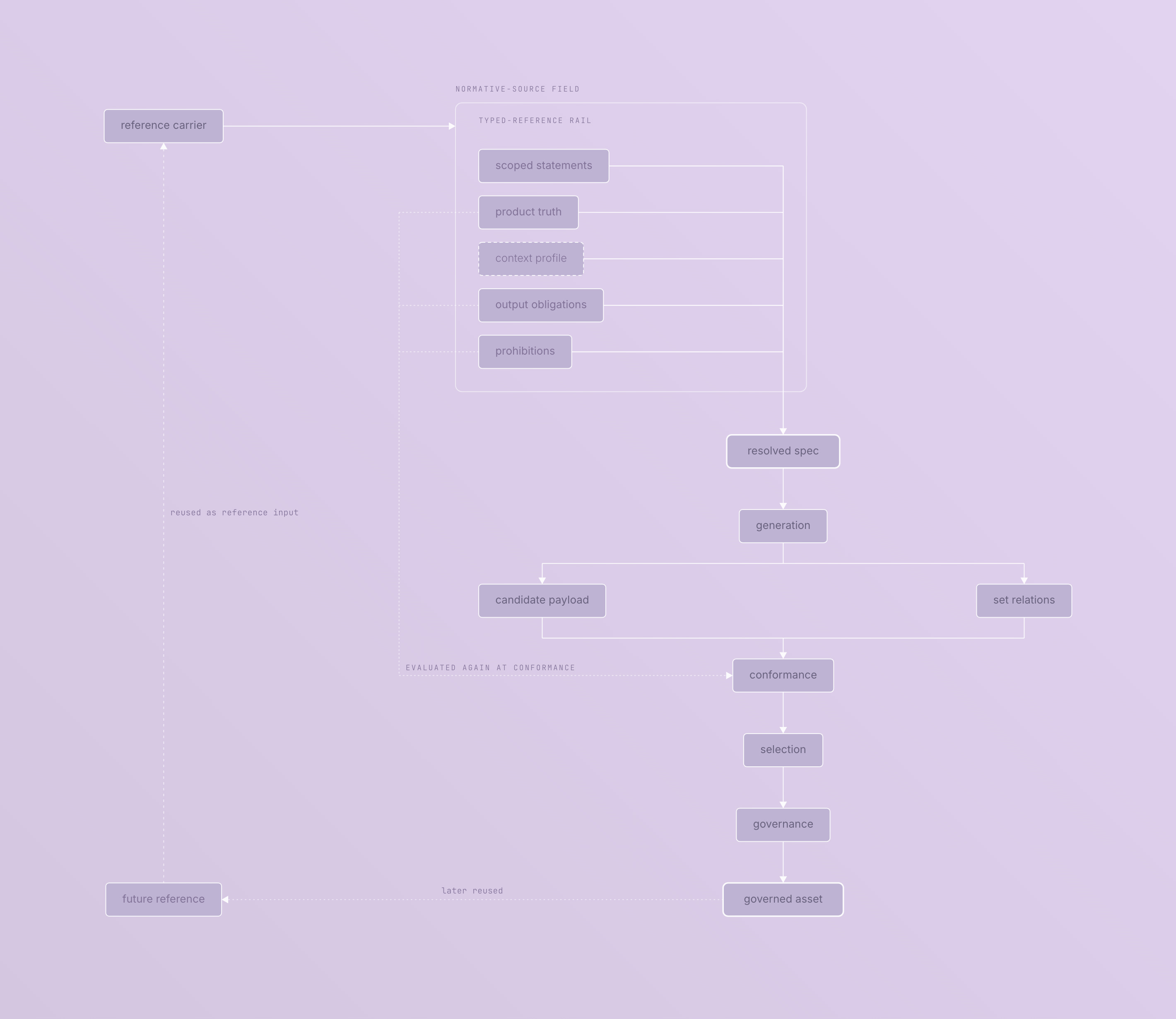
They meet at the slot. They do not descend from one another. The product’s truth does not inherit from the campaign’s mood.
References are worth singling out because they are easy to misfile. A reference is not another independent branch in the hierarchy. It is a carrier. It can remain directly operative, or it can support an articulated statement when translation is needed. But a model’s interpretation of an authoritative reference does not automatically inherit the reference’s authority.
So the architecture is not the list of dimensions. It is where each decision is made, what it inherits, what merely shapes or judges it, and how all of it converges into the specification for one image. A generation prompt is assembled at the end of that convergence. It is not the architecture.
Convergence needs a way to say no
Convergence does not mean consensus.
The brand language may call for soft light while a detail context calls for harder raking light. A packet may ask for a dramatic departure. Product truth may require a material or silhouette to remain legible. The slot may require a crop that threatens that truth. Two reusable context profiles may be bound to the same output and disagree.
A hierarchy alone cannot resolve those collisions. “More local wins” is not enough. List order is not authority. A reference is not a trump card. And calling every unresolved case “human judgment” invites the human to invent source truth that was never supplied.
The model therefore needs a small resolution calculus. Statements are activated only if they are current, applicable, and authorized. Compatible statements combine. A local statement specializes an inherited one only within the range the inherited rule permits. A departure beyond that range needs an authorized exception. Missing truth or missing authority becomes an input problem. Mutually incompatible non-negotiables make the specification unsatisfiable.
The possible outcomes are not all versions of “approved”:
resolved
judgment required
authorization required
input required
unsatisfiable
We pressure-tested that calculus on thirteen deliberately conflicting, closed-world cases with two independent fresh readers. Twelve cases converged directly on the pre-registered outcome. The thirteenth exposed a missing fact in the fixture itself — the designated exception authority had not been stated — and both readers correctly refused to invent it. No reader let profile order decide, promoted an unvalidated interpretation into authority, or hid an unsatisfiable collision.
That is not universal proof. It is one synthetic substrate and two readers. But it moves the convergence model from a plausible diagram to a determinate, usable mechanism at the tested depth.
What the image tests did and did not show
The conflict test above did not inspect images. The earlier image tests asked a different question.
Before the current architecture existed, an earlier, flatter register was fixed and tested blind. Two bodies of preexisting commercial imagery were assembled, anonymized, stripped of source information, and handed to fresh vision models that did not know the brands.
The first was a mature furniture and interiors aesthetic, highly coherent — a strong, clean signal. The second was a broader direct-to-consumer apparel and home set, with human casting, product detail, and far more context variation — a weaker, noisier signal.
Both runs showed that real commercial images could be organized across the visual decision areas the model was circling. Recurring visual regularities appeared in each body of work, and the split between a relatively stable language and a context-specific setup was observable. Where set relationships could be seen, they hung together.
But those tests did not produce the corrected architecture. The trigger came later, when I questioned whether “post-processing” named something visible in the image or merely a stage in how the image was made. That small category catch prompted a broader ontology/topology audit. Two independent critiques then exposed deeper errors in what counted as payload, what instead acted as product truth, obligation, prohibition, or conformance, and how the pieces inherited and converged. The revised architecture came from that adversarial audit and the adjudication that followed — not from the image runs.
The image tests could show that visual evidence populated the model’s territory. They could not prove that the model had drawn the right borders or the right arrows.
The two test classes now support two different claims:
The image tests exercised the retained visual dimensions.
The resolution test exercised how conflicting inputs can converge without silent invention.
Both results are real. Both are bounded. Neither is a license to call the architecture complete.
The prompt is the last mile
This changes the role of prompting.
The model does not need another paragraph of adjectives. It needs a resolved specification: the inherited brand grammar, the context-specific setup, the product truths that must hold, the slot’s obligations, the references typed by what they anchor, and explicit boundaries on what may vary.
The prompt becomes a rendering of that structure for a particular model at a particular moment — and that structure is a far more durable object than the prompt itself.
It also changes brand intake. A future system should not need a human to hand-author every visual rule from scratch. It should be able to take in a partial, messy body of brand imagery, separate recurring visual regularities from context variation, report what the sample does and does not support, and ask where the evidence is thin. The human still owns meaning, validation, and judgment. The human should not have to organize every visual signal by hand before the system can begin.
The image is a system
An image is not one thing.
It carries a stack of visual decisions with different sources, different homes, different amounts of allowed variation, and different lifetimes. Some are inherited; some are set locally. Some are content; some shape or judge that content. Some conflicts resolve mechanically; some need authorization, missing input, or an explicit declaration that no valid specification exists.
Once that stack is explicit, a brand can preserve coherence without forcing sameness. A campaign can specialize without drifting. A product can stay true while the context changes. A production system can ask a model for variation without asking it to invent the grammar it is supposed to follow.
The point is not to reduce image-making to fields.
The point is to make the visual decisions legible enough to inherit, vary, resolve, select, govern, and carry across tools.
/// /// /// ASK
repo https://github.com/apexSolarKiss/asset-pipeline-ASK
prior pieces >>